Most "100% natural" claims on a skincare label are unverifiable in about ten seconds — you just need to know where to look.
- Read the INCI list before the marketing copy — ingredient order shows what's actually in the bottle.
- A real natural skincare claim names a certifier and license number, like COSMOS Natural from Ecocert.
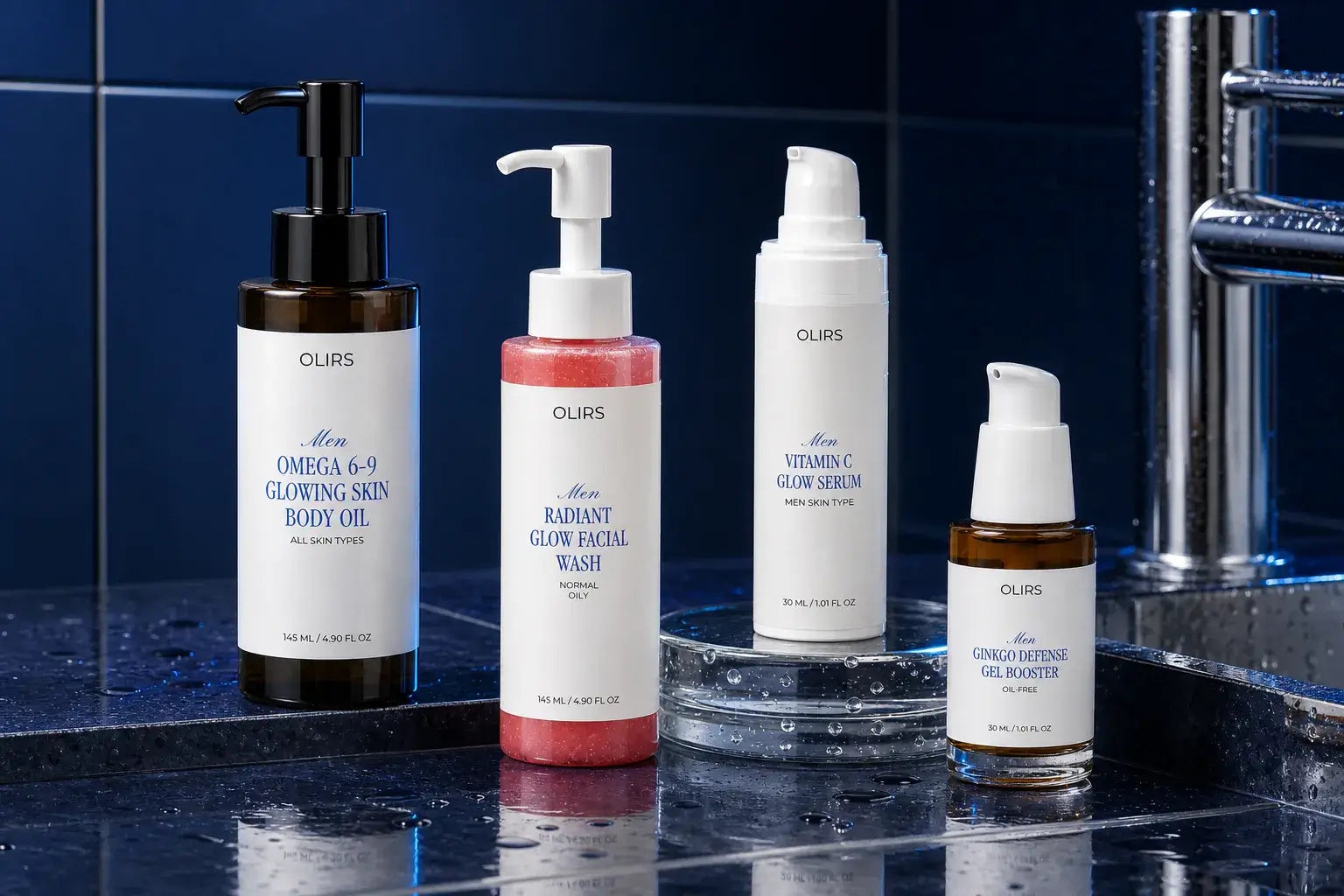
- OLIRS discloses COSMOS Natural, Vegan, and Cruelty-Free status openly: verdict is read the label yourself, don't take the claim on faith.
- 'From Farm To Face' sourcing only means something when a brand names the region and extraction method.
- Skip any 'all-natural' claim with no certifier attached — that's the fastest tell it's unverifiable.
Why this matters
"Natural" has no legal definition on a skincare label in the US or the EU. Any brand can print it. That's exactly why the men's skincare category is flooded with the word and almost never backs it up with anything a stranger could check.
OLIRS built its whole approach around the opposite bet: name the certifier, publish the ingredient list, and let the reader verify it instead of asking him to trust a bottle. That habit — reading the label before you buy — is the entire skill this guide teaches. It takes five minutes once you know the steps.
What you'll need
- The product's ingredient list (INCI), either printed on the packaging or listed on the product page
- A phone or laptop and about five minutes
- Access to a public ingredient database (INCIDecoder, EWG Skin Deep, or the certifier's own registry)
- The name of any certification claimed on the label (COSMOS Natural, Leaping Bunny, USDA Organic, etc.)
The steps
1. Read the ingredient list top to bottom, not the front of the label
INCI (International Nomenclature of Cosmetic Ingredients) lists ingredients in descending order by concentration, down to 1%. Below 1%, brands can list ingredients in any order. This means the first five names on the list tell you more about the formula than any word on the front of the bottle.
If a serum's front label screams "natural" but the first ingredient after water is a synthetic silicone, the claim is describing a minority of the formula. Common mistake: stopping at the first three ingredients and assuming the rest doesn't matter — actives at 1-2% concentration still show up further down and are often the whole point of the product.
2. Confirm the certification is real, not a printed word
"Natural" without a logo is a marketing adjective. "Natural" with a certification mark — COSMOS Natural from Ecocert, for example — is a claim a third party audited. COSMOS Natural means an outside body reviewed every ingredient and how it was extracted, not just the final blend.
That distinction matters because COSMOS Natural and COSMOS Organic are two separate certifications with different thresholds. A brand holding one is not automatically entitled to claim the other. If a label says "organic" but the only mark you can find is COSMOS Natural, that's a mismatch worth asking about directly.
3. Look up the license number in the certifier's public registry
Every legitimate COSMOS certification has a license number tied to the certifying body, usually Ecocert or Cosmebio. If a brand claims the certification but can't produce a number, or the number doesn't resolve in the registry, treat the claim as unverified. This step alone eliminates most fake natural claims — it costs nothing and takes under two minutes.
4. Separate sourcing claims from formulation claims
"From Farm To Face" type language is a sourcing claim: it says something about where raw ingredients came from and how they were processed, not what percentage of the formula is plant-derived. A brand can have a legitimate natural certification and still not be able to name the exact farm region for every ingredient in every product — sourcing data gets built product by product, not catalog-wide.
On All-In-One Facial Oil, the jojoba, rosehip, and sea-buckthorn are each tied to a named region and a cold-pressed extraction method. That's a sourcing claim you can actually check against the ingredient origin data. A slogan with no region and no extraction method attached is decoration, not proof.
5. Check any percentage or study citation against the primary source
"95% naturally derived" or "clinically proven" needs a source with a year and a publication attached. If the brand can't point to the study, the number is unverifiable and should be treated as marketing, no matter how specific it sounds. A real citation reads like "Flament 2013" or "Ghadially 1992," not "studies show."
Common mistake: accepting a percentage claim because it sounds precise. Precision is not the same as sourcing.
6. Flag treat/cure/heal language as a red flag, not a selling point
Regulated cosmetics in the US and EU are legally barred from claiming to treat, cure, or heal a skin condition — that language belongs to drugs, not cosmetics. A brand using it is either misclassifying its own product or ignoring the rule. Appearance language — "looks smoother," "appears more even" — is the honest, compliant version of the same idea.
7. Check what's absent, not just what's present
Paraben-free, gluten-free, nut-free — these are formulation exclusions, and a brand serious about them lists them explicitly rather than burying them in fine print. What's missing from a formula is often more checkable than what's claimed to be inside it, because an exclusion is binary: either the ingredient is there or it isn't.
Troubleshooting
- The ingredient list is a photo, not text. Type the first ten ingredient names manually into a search engine or ingredient database — don't rely on OCR from a screenshot, it misreads INCI names constantly.
- The certification logo looks unfamiliar. Search the certifying body's name plus "registry" or "verify license." Real certifiers publish public lookup tools; ones that don't are usually self-issued seals with no auditing behind them.
- The brand cites a study with no year. Treat it as unverifiable until a year and journal are attached. A real citation is checkable in under a minute; a vague one is designed not to be checked.
- Two nearly identical products, different claims. If a catalog has two similar formulas at different price points making different natural claims, ask which one actually holds the certification — don't assume the pricier one does.
- The word "organic" appears without a COSMOS Organic mark. COSMOS Natural and COSMOS Organic are not interchangeable. A brand certified Natural cannot claim Organic status without a separate audit.
- No certifier is named at all. "Naturally sourced" and "nature-inspired" carry zero certification weight — they're phrasing, not audits.
Tools and resources
- A public INCI database (INCIDecoder, EWG Skin Deep) to look up unfamiliar ingredient names in under a minute each
- The certifying body's own registry — Ecocert publishes license lookups for COSMOS Natural and COSMOS Organic
- The product's own ingredient page, read before the marketing copy on the same page
- A comparison read like natural face wash for oily skin if you're applying this check while shopping cleansers specifically
What to do next
Once you can read an ingredient list and spot a real certification in under five minutes, apply the same scrutiny to routine order — actives that are genuinely useful can still be applied in the wrong sequence and cancel each other out. A simple skincare routine without the guesswork walks through cleanser, serum, and moisturiser order so the ingredients you just verified actually get to do their job.
FAQ
How to tell if natural skincare is real?
Check for a named third-party certifier with a public license number, like COSMOS Natural from Ecocert, and read the ingredient list in order rather than trusting the front-of-bottle claim. If neither exists, the natural claim is unverifiable.
Is 'natural' a regulated term on skincare labels?
No. In the US and EU, 'natural' has no legal definition on a cosmetics label as of 2026, so any brand can print it without proof. A named certification, not the word itself, is what's checkable.
What's the difference between COSMOS Natural and COSMOS Organic?
COSMOS Natural certifies the formulation and extraction methods used; COSMOS Organic requires a higher threshold of certified organic raw material. A brand holding one cannot claim the other without a separate audit.
Does 'clinically proven' mean anything without a source?
Not on its own. A real clinical claim comes with a study name, year, and journal you can look up. A claim with no citation is a marketing phrase, not evidence.
How much of a formula does the ingredient order actually reveal?
Ingredients above 1% concentration are listed in descending order, so the first five to seven names tell you the bulk of the formula. Below 1%, order can be arbitrary, which is where many actives sit.
Can a certified natural product still contain synthetic ingredients?
Yes, within the certifier's allowed limits — COSMOS Natural permits a small percentage of synthetic preservatives and stabilizers under defined thresholds. Certification means audited limits, not zero synthetics.
What does 'From Farm To Face' actually require to be true?
It requires a named region of origin and a stated extraction method for the specific ingredients in that specific product, not a catalog-wide slogan. Only formulas with that origin data attached can honestly carry the phrase.
Should I trust a percentage like '95% natural origin'?
Only if the brand names the calculation standard behind it, usually ISO 16128. Without that reference, the percentage is a marketing number with no audit trail.
One last thing
The most overlooked check isn't the ingredient list — it's the extraction method. COSMOS Natural audits don't just confirm what's in a bottle, they confirm how it was pulled out of the plant, because cold-pressing and solvent extraction leave different residues behind. Two products can list the identical top-line ingredient and still earn different certification outcomes because of that one variable. Ask about it, and watch which brands actually have an answer.