News


How to Use Bakuchiol for Men Without Irritation (2026)
Bakuchiol is the plant-derived alternative men reach for when retinol turns their face into a peeling, red mess. It works slower and gentler — but "gentler" doesn't mean "foolproof," and going in wrong still causes irritation. TL;DR Start bakuchiol twice a week at night — that's the core of how to use bakuchiol for men without irritation. Buffer every application with a moisturiser to cut down on redness and tightness. Bakuchiol works slower than retinol — expect visible texture change around week 8-12, not week one. Skip AHAs or vitamin C the same night until your skin has adjusted for at least three weeks. Patch test on your jaw for three nights before it touches the rest of your face. Why this matters Most irritation complaints about bakuchiol aren't about the ingredient — they're about the rollout. Men buy a bottle, apply it every night starting day one, stack it with a vitamin C serum in the morning, and then blame the actives when their skin gets tight and flaky by week two. Bakuchiol is a plant compound that mimics some of retinol's effects on skin turnover without the same level of dryness. That's the whole pitch of it as a retinol alternative — read the OLIRS guide for first-time retinol alternative users if you want the mechanism explained in more depth. But "less irritating than retinol" is a comparison, not a guarantee. In 2026, the men who get the best results from bakuchiol are the ones who treat it like any new active: slow start, real patch test, buffer with hydration. This guide is the routine, step by step — what to do the first night, what to expect by week four, and what to do when something goes wrong. What you'll need A bakuchiol serum or oil A gentle cleanser you already use A moisturiser to buffer application (a retinol alternative moisturiser works, but a plain hydrating one is fine too) A small patch of skin — jawline or behind the ear — for the first three days A calendar or phone reminder, since the frequency schedule matters more than the product The steps 1. Patch test before it touches your whole face Apply a pea-sized amount to your jawline or behind your ear for three consecutive nights before using it anywhere else. This tells you how your skin reacts without risking a reaction across your whole face. What to look for: mild pinkness that fades by morning is normal. Anything that's still red, itchy, or swollen at hour 24 means stop and reconsider the concentration or frequency. Common mistake: skipping this step because bakuchiol is marketed as gentle. Gentle relative to retinol still means it's an active ingredient, and everyone's skin barrier is different. 2. Start at two nights a week, not daily Apply bakuchiol only on, say, Tuesday and Friday nights for the first two to three weeks. This gives your skin barrier time to adjust to the increased cell turnover without compounding irritation night after night. Daily use from day one is the single biggest reason men report redness and flaking. The ingredient isn't the problem — the ramp-up speed is. 3. Apply to clean, dry skin, before moisturiser Cleanse, pat dry completely, then apply bakuchiol before your moisturiser. Applying to damp skin increases absorption speed, which sounds good but actually raises irritation risk for a first-timer. This matters because it accomplishes what the product is meant to do: deliver the active to skin that's ready for it, in a controlled dose, rather than an accelerated one. 4. Buffer every application with a moisturiser Follow bakuchiol with a moisturiser every single time, no exceptions in the first month. A hyaluronic acid face cream or an oil-free zinc face gel works here depending on whether your skin runs dry or oily. The moisturiser isn't optional padding — it slows how fast the active penetrates and reduces transepidermal water loss, which is most of what causes that tight, flaky feeling. 5. Hold off on other actives the same night Don't stack bakuchiol with an AHA, BHA, or vitamin C serum on the same night, especially in month one. Two actives at once multiplies irritation risk instead of adding results. If your routine already includes an exfoliant, alternate nights: bakuchiol on Tuesday and Friday, exfoliant on Sunday and Wednesday. Give your skin at least 48 hours between different actives while you're still calibrating. 6. Increase frequency slowly, not all at once After three weeks with no reaction, move to every other night. After six to eight weeks with no reaction, move to nightly if you want. Jumping straight from twice-a-week to nightly undoes the entire point of the ramp-up. Common mistake: seeing no visible change at week three and assuming more frequency equals faster results. Bakuchiol's turnover effect compounds over weeks, not days — impatience here is what triggers the exact irritation you were trying to avoid. 7. Keep morning SPF in the routine Bakuchiol doesn't carry the same photosensitivity warning that retinol does, but any active that increases cell turnover benefits from sun protection during the day. This isn't a claim about what bakuchiol does or doesn't require — it's just a reasonable habit for anyone changing their skin's surface layer. 8. Track texture over weeks, not days Take a photo in the same light once a week. Bakuchiol's effect on the appearance of fine lines and uneven texture shows up gradually — most men notice a difference in the 8-to-12-week range, not the first 10 days. This won't fix deep scarring or reverse sun damage. It helps skin look smoother and more even over time. That's the honest ceiling, and it's worth knowing going in. Buffer products for a bakuchiol routine Oil-Free Zinc Face Gel for Men Simple moisturiser for men, works as a stand-alone step or paired with an active serum. €26 Hyaluronic Acid Face Cream for Men Simple, easy-to-use moisturiser built to sit alongside an active serum step. €18.70 Troubleshooting Redness and tightness after the third use. Drop back to once a week for the next two weeks before trying twice again. Your barrier needs more recovery time between applications than you gave it. Small breakouts around week two. This can be the skin purging as turnover speeds up, or it can be the serum sitting on top of too much moisturiser and clogging pores. Try applying a thinner layer before you assume it's the ingredient. Product balls up or pills on your skin. This usually means you're layering it over a moisturiser that hasn't fully absorbed, or mixing textures that don't sit well together. Apply bakuchiol first, wait 60 seconds, then moisturise. Skin feels persistently dry by week three. Add a second moisturiser layer at night, or switch to a heavier cream instead of a gel. Bakuchiol increasing turnover naturally increases water loss until your barrier catches up. No visible change after a month. Normal. Bakuchiol works on a slower timeline than retinol — give it the full 8-to-12-week window before deciding it's not doing anything. Irritation that doesn't fade after 48 hours. Stop use and let skin fully recover before restarting at a lower frequency. If shaving is also part of the irritation picture, the face serum for razor burn and irritation guide covers how to separate shaving irritation from active-ingredient irritation. Tools and resources A bakuchiol serum or oil, applied on a fixed schedule, not daily by default A retinol alternative moisturiser to buffer the active on application nights A gentle cleanser — harsh cleansers before an active night compound dryness SPF for daytime, regardless of what active you used the night before A weekly photo log to judge texture change honestly instead of guessing What to do next Once bakuchiol is settled into your routine at three or more nights a week with zero irritation, the next question is usually sequencing it with other actives — vitamin C in the morning, an exfoliant on off-nights, that kind of thing. That's a separate routine-building question, and it's worth getting the order right before adding anything else. FAQ How do you use bakuchiol for men without irritation? Start at two nights a week, apply to dry clean skin before moisturiser, and buffer every application with a hydrating cream. Increase frequency only after three weeks with no reaction. Is bakuchiol better than retinol for men? Bakuchiol tends to cause less dryness and peeling than retinol, but it works more slowly on fine lines and texture. It's the trade most men make when retinol has already caused irritation. How long does bakuchiol take to work? Most men notice a visible change in skin texture and evenness around 8 to 12 weeks of consistent use. Expecting results in the first two weeks is the most common reason people quit early. Can you use bakuchiol every night? Only after a ramp-up period. Start at two to three nights a week for the first three weeks, then increase gradually if your skin shows no redness or flaking. Can you use bakuchiol and vitamin C together? Yes, but not always on the same application. Vitamin C in the morning and bakuchiol at night is the safer split while your skin is still adjusting. Does bakuchiol require SPF? Bakuchiol doesn't carry the same sun-sensitivity warning as retinol, but daytime SPF is a reasonable habit any time you're changing your skin's surface layer. Why does bakuchiol cause breakouts sometimes? A short purge phase can happen as cell turnover speeds up, or breakouts can come from layering too much moisturiser on top. Thinning out your layers usually resolves it within a week. What percentage of bakuchiol should men start with? Concentration matters less than frequency for most first-time users. Sticking to twice-weekly application controls irritation more reliably than hunting for a specific percentage. One last thing The ramp-up schedule matters more than the product you buy. A man using a mediocre bakuchiol serum twice a week with a moisturiser buffer will see fewer problems in 2026 than a man using the best bottle on the market nightly from day one. Frequency is the lever that actually controls irritation — not the ingredient list. Related guides Bakuchiol night serum for first-time retinol alternative users A simple skincare routine for men who hate fuss Face serum for razor burn and irritation Face serum for dry skin in your 30s
Learn more
How to Fix an Oily Nose by Midday: 2026 Men's Guide
Your nose gets oily faster than the rest of your face because it has more oil glands packed into less skin — that's anatomy, not a hygiene failure. Fix the routine, not the shame. TL;DR An oily nose by midday comes from sebaceous gland density, not dirty skin — over-washing makes it worse. Two cleanses a day, lukewarm water, and an oil-free zinc face gel is the baseline fix for 2026. Blotting paper is a stopgap, not a solution — it removes oil but does nothing about the gland producing it. If your nose is oily but your cheeks are dry, you have combination skin, not oily skin — treat them differently. Why this matters The nose sits in the T-zone, where sebaceous glands are denser and larger than anywhere else on the face. That's a structural fact, not a verdict on how well you take care of yourself. The problem most men create is trying to fix a gland with a scrub — washing three or four times a day, using a bar of hand soap because it's already in the shower, or reaching for the driest gel in the drugstore aisle. Strip the skin's surface oil too hard and too often, and the skin reads it as a shortage. It compensates by producing more. That's why the guy who washes his face five times a day is often shinier by 2pm than the guy who washes twice. An oil-free zinc face gel works because it manages oil without stripping the barrier that tells your skin to stop overproducing. This isn't about eliminating oil. Sebum protects and waterproofs skin — you need some of it. The goal for 2026 is regulating output, not shutting it off. What you'll need A gentle, low-foam cleanser (not bar soap, not a scrub) An oil-regulating gel or lotion labeled oil-free or non-comedogenic Blotting papers or a clean cotton cloth, kept in a bag or desk drawer Lukewarm water — not hot 90 seconds, twice a day Patience through week one, when oil output can temporarily spike as skin recalibrates The steps 1. Cut down to two washes a day Morning and night. That's it. Every extra wash strips more surface lipid, and the skin overcorrects by the next morning. If you're washing after the gym too, that's fine — count it as one of your two, and skip the evening wash instead of stacking a third. Expected outcome: less rebound shine by hour six or seven. Common mistake: washing every time the nose looks shiny during the day. That resets the cycle instead of breaking it. 2. Switch to lukewarm water, not hot Hot water feels like it's degreasing skin, but it also breaks down the lipid barrier faster than cool or lukewarm water does. A weaker barrier means faster water loss, which again reads to your skin as "produce more oil." Expected outcome: less tightness right after washing, less shine within a few hours. Common mistake: finishing a hot shower with a hot-water face rinse out of habit. 3. Use a cleanser built for oily and combination skin, not a bar Bar soap sits on the alkaline end of the pH scale, well above skin's natural 4.5–5.5 range. That mismatch is part of why a bar soap face wash leaves skin tight for twenty minutes and shiny two hours later. A face wash formulated for oil control, like the radiant glow facial wash, targets the T-zone without pushing skin that far off its normal pH. Expected outcome: cleaner-feeling skin without the tight, stretched sensation. Common mistake: using the same bar you use on your body, on your face, because it's already in your hand. 4. Apply an oil-free gel moisturizer, even on an oily nose Skipping moisturizer on an oily area is the single most common mistake in this routine. Dehydrated skin still produces oil — it just also loses water, which makes the shine look worse and the texture look rougher. A lightweight, oil-free gel hydrates without adding the occlusive weight of a cream. Expected outcome: less midday shine because skin isn't compensating for water loss. Common mistake: treating "oily" and "hydrated" as opposites. They're not related the way most men assume. 5. Add a targeted gel for the T-zone only You don't need to treat your whole face like it's oily if only your nose and forehead are. A clarifying gel applied just to the T-zone after your regular moisturizer lets you treat the actual problem area without over-drying your cheeks and jawline. Expected outcome: more even shine control across the whole face, not just the center panel. Common mistake: applying a strong oil-control product across the entire face when only the nose needs it. 6. Keep blotting paper as a midday tool, not a fix Blotting paper lifts surface oil in about ten seconds and doesn't disturb sunscreen or the rest of your routine. Use it once, mid-afternoon, if the routine above hasn't fully caught up yet — which is normal in the first two to three weeks. Expected outcome: a temporary reset that buys you a few hours. Common mistake: rubbing the paper across the skin instead of pressing and lifting, which just spreads the oil instead of removing it. 7. Check your pillowcase and phone screen Skin transfers oil onto anything it touches, and both surfaces transfer it right back. A pillowcase changed weekly and a phone screen wiped daily removes a source of reintroduced oil that has nothing to do with your skincare routine at all. Expected outcome: fewer random breakouts along the cheek and jaw where the phone rests. Common mistake: assuming skincare alone controls every input. It doesn't — fabric and glass hold oil too. “Washing more doesn't turn off the tap on an oily nose — it turns up the pressure.”Troubleshooting Nose is still shiny two hours after washing. You're likely still over-cleansing elsewhere in the day. Drop to exactly two washes for two full weeks before changing products again — most men quit the plan before the skin has time to recalibrate. Skin feels tight and flaky, but the nose is still oily. That's combination skin, not oily skin. Use the oil-free gel only on the T-zone and a richer, non-oil-free moisturizer on the cheeks and jaw. Small breakouts appeared after starting a new gel. New actives can cause a short adjustment period. If bumps persist past two weeks or spread beyond the T-zone, stop and reassess — this isn't something to push through indefinitely. Blotting paper leaves a chalky residue. That's usually a paper with added powder. Switch to a plain, powder-free blotting sheet or a clean piece of tissue. Oil comes back faster after workouts. Sweat and sebum are different fluids, but heat from exercise does increase gland output temporarily. A quick post-gym cleanse counts as one of your two daily washes — don't stack it on top. Product stings when applied. Stop using it on broken or irritated skin, patch test on the inside of your forearm for 24 hours before trying again on your face, and don't layer multiple active ingredients until you know how your skin handles each on its own. Built for the T-zone Oil-Free Zinc Face Gel for Men Lightweight, oil-free moisturiser built for men, works as a stand-alone step or inside a full routine. €26 Hyaluronic Acid Face Cream for Men Simple, easy-to-use moisturiser for men, layers into any oil-control routine. €18.70 Tools and resources Oil-free gel moisturizer for daily use on the T-zone A low-foam, pH-balanced facial wash instead of bar soap Blotting papers, powder-free, for midday touch-ups A targeted gel for the nose and forehead only, applied after moisturizer Read the certification and INCI list on whatever gel you buy — don't take a label's oil-control claim on faith. OLIRS lists its COSMOS NATURAL certification on every product page for exactly this reason. What to do next If the oily nose is part of a bigger pattern — shine across the whole face, not just the center panel — the fix looks different. A deeper breakdown of cleansers built for oily skin covers how to tell the difference between an oily T-zone and genuinely oily skin, and how the product choices change once the whole face is involved. FAQ What causes an oily nose by midday for men? The nose has more and larger sebaceous glands than the rest of the face, so it produces oil faster. Over-washing or hot water makes it worse by stripping the skin barrier, which triggers more oil production to compensate. Does washing your face more often stop nose oil? No, washing more than twice a day usually makes an oily nose worse. Each wash strips surface lipids, and skin overcorrects by producing more oil before the next wash. What ingredient helps control oil without drying skin? Zinc-based, oil-free gel formulas manage shine without the heavy, pore-clogging feel of a rich cream. Look for products labeled oil-free or non-comedogenic and check the ingredient list rather than the front-of-bottle claim. Is an oily nose a sign of dehydrated skin? Yes, often. Dehydrated skin still produces oil and can look shinier because it's also losing water, which is why skipping moisturizer on an oily nose usually backfires. How many times a day should men wash an oily nose? Twice a day, once in the morning and once at night, is the standard baseline for 2026. Add a third wash only after a workout, and drop one of the other two that day instead of stacking three. Can diet affect an oily T-zone? Diet can influence overall skin oiliness for some men, though the effect varies person to person and isn't a guaranteed fix on its own. Routine and product choice have a more direct, controllable impact on nose shine specifically. Does blotting paper fix oily skin long term? No, blotting paper removes surface oil for a few hours but does nothing to change how much oil the gland produces. It's a midday tool, not a substitute for the underlying routine. What's the difference between oily skin and just an oily nose? An oily nose alone, with normal or dry cheeks, is combination skin — the two areas need different products. Oily skin across the whole face needs a uniform oil-control approach rather than a T-zone-only fix. One last thing Most men treat an oily nose as a cleansing problem and never touch the moisturizer step — that's backwards. Skin that's losing water through a compromised barrier will look shinier no matter how many times you wash it, so the gel you apply after cleansing matters more than the cleanser itself. Fix the barrier first, and the shine problem gets smaller on its own. Related guides A simple skincare routine for men who hate fuss
Learn more
Anti Aging Serum for Men Over 50: 2026 Buying Guide
An anti-aging serum for men over 50 has one job: work with skin that's thinner, drier, and slower to repair than it was at 35, without setting off a barrier that's already stretched thin. Olirs breaks down what actually matters at this age and which formulas in the current 2026 catalog hold up when you read the INCI list instead of the headline. TL;DR For an anti aging serum for men over 50, Peptide Firm-Look Serum's Hexapeptide-11 makes the strongest firmness case — Buy. Advanced Night Renewal Serum swaps retinol for bakuchiol, a gentler option for thinning skin — Buy. Overnight AHA Exfoliating Serum improves texture but start twice weekly after 50, not nightly — Consider. Visible Aging Defence Box bundles serum, moisturizer and eye care for €97.40 — Consider. Why this matters Skin over 50 doesn't behave like skin over 30. Oil production drops, cell turnover slows, and the barrier takes longer to recover from anything abrasive. A serum built for a 28-year-old's oily T-zone can leave a 55-year-old's face tight and flaking inside two weeks. The fix isn't a stronger serum. It's picking the right mechanism for the skin you actually have in 2026, not the one the ad copy is selling. That's a smaller, more specific list than most "best anti-aging" roundups admit. Who this guide is for This is written for a man over 50 who hasn't built a routine yet, or who's still using a bar of soap and calling it a day. He's not chasing a younger face in the mirror — he wants his skin to look less tired and less rough by the time he's shaving in 2026's back half, and he wants to know what's actually in the bottle before he buys it. If that's you, the Peptide Firm-Look Serum is a reasonable place to start reading labels, not buying blind. He's also skeptical, correctly. The category is full of "clinically proven" claims with no citation attached. This guide skips those and sticks to mechanism: what an ingredient does, and what it doesn't. What to look for in an anti-aging serum for men over 50 Peptides for firmness Peptides are short chains of amino acids that signal skin to behave like it's repairing itself. Hexapeptide-11, specifically, is one of the more studied signal peptides for supporting a firmer-looking appearance. At 50+, this matters more than at 30, because natural collagen renewal has already slowed and a serum that only hydrates won't touch firmness. A retinol alternative, not retinol itself Retinol is effective and it's also the ingredient most likely to leave a 50-plus barrier red and peeling, especially skin that's already drier than it used to be. Bakuchiol is the plant-derived option men reach for when retinol causes irritation. It works more slowly. That's the trade, and it's worth making at this age. Layered hydration, not one thick cream Skin over 50 loses water faster than it did at 30. Hyaluronic acid at more than one molecular weight — one size sitting on the surface, a smaller one reaching deeper — does more for actual moisture retention than a single heavy cream sitting on top of dry skin. Antioxidant support for the mornings Vitamin C paired with ferulic acid supports skin against daily environmental stress and helps even out the look of tone. It's a morning-layer ingredient, not a night one — pairing it under sunscreen does more than pairing it under a night oil. Texture correction, applied carefully AHAs like lactic acid lift away dead surface cells and can noticeably improve rough texture. On skin over 50, that same acid can also compromise a barrier that's already slower to bounce back, so frequency matters more than concentration. Certification you can actually check COSMOS Natural means a third party audited every ingredient and how it was extracted. It's not a badge to skim past — it's a mechanism you can verify yourself by reading the certificate, the same way you'd check an INCI list before buying. The top picks Peptide Firm-Look Serum — the safe pick The spec that matters: Hexapeptide-11 combined with two molecular weights of hyaluronic acid, at €42.40 for the standard size. This is the pick for a man who wants one serum doing the firmness job without guesswork, and its aloe sourcing is traced to the Mediterranean basin, which is more origin detail than most of the catalog can offer. Verdict: Buy — it's the most defensible first serum on this list for someone over 50 building a routine from zero. Advanced Night Renewal Serum — the retinol alternative The spec that matters: bakuchiol paired with rosehip and evening primrose, priced at €35.40. It's the gentler evening option for a barrier that's already thinner than it was a decade ago, and it works on the same texture and fine-line concerns retinol targets, just on a slower timeline. Verdict: Buy if you've tried retinol before and it left your face raw; Consider if you've never used an active before and want to start even slower. Overnight AHA Exfoliating Serum — the texture pick The spec that matters: lactic acid at a concentration meant for overnight use, €32.40, paired with hyaluronic acid to offset the drying effect. Texture correction is real here, but skin over 50 recovers slower from any exfoliation, so two nights a week beats nightly use for the first month. Verdict: Consider — strong pick for rough texture, but read the frequency guidance before you commit to daily use. Visible Aging Defence Box — the full routine The spec that matters: three products in one box at €97.40, built around the Peptide Firm-Look Serum plus multi-molecular hyaluronic acid support. It removes the guesswork of assembling a routine product by product. Verdict: Consider — it's the right call for a man who wants a full 2026 routine in one order rather than three separate decisions. Featured for men over 50 Peptide Firm-Look Serum Daily peptide serum for smoother-looking, hydrated skin with two molecular weights of hyaluronic acid. €42.40 Advanced Night Renewal Serum Evening bakuchiol oil serum for smoother-looking, comfortable skin. €35.40 Visible Aging Defence Box Three-product routine built around peptide serum and multi-molecular hyaluronic acid. €97.40 What to avoid at 50+ Anything marketed as "strong" or "maximum strength." At this age a serum that irritates the barrier undoes whatever firmness or texture benefit it's chasing. Slower and consistent beats aggressive and abandoned after a week. Fragrance-heavy formulas layered daily. Skin over 50 reacts to fragrance more, not less, than it did a decade ago — check the INCI for where fragrance sits on the list. A serum you can't verify. If a brand won't show the INCI or name the certification body, that's the answer. Don't take a label's word for it — check it. Peptides don't reverse anything. They support the appearance of firmer skin. That distinction is the whole reason to read the label instead of the headline. Anti-aging serum comparison for men over 50 Product Key ingredient Best for Verdict Peptide Firm-Look Serum Hexapeptide-11 + multi-weight hyaluronic acid First-time serum buyers wanting firmness Buy Advanced Night Renewal Serum Bakuchiol, rosehip Sensitive skin avoiding retinol Buy Overnight AHA Exfoliating Serum Lactic acid Rough texture, used 2x/week Consider Vitamin C Glow Serum Stabilised vitamin C, ferulic acid Morning layering under SPF Consider Visible Aging Defence Box Peptides, hyaluronic acid A complete routine in one order Consider FAQ What's the best anti-aging serum for men over 50? Peptide Firm-Look Serum is the strongest single-product pick for 2026, built around Hexapeptide-11 and two molecular weights of hyaluronic acid at €42.40. Men avoiding actives entirely should start there before layering anything else in. Is bakuchiol better than retinol for men over 50? Bakuchiol works more slowly than retinol but causes less irritation on skin that's already thinner and drier past 50. Advanced Night Renewal Serum uses bakuchiol for that reason — it's the gentler starting point, not necessarily the stronger one. How much does an anti-aging serum for men over 50 cost? Single serums in the 2026 Olirs lineup run from about €26 to €42.40 depending on the actives inside. A full three-product routine like the Visible Aging Defence Box runs €97.40. Can men over 50 use AHA exfoliating serums nightly? Start at twice a week, not nightly. Skin over 50 takes longer to recover from exfoliation, and daily use of an AHA can compromise the barrier before it improves texture. Do peptide serums actually firm skin? Peptides support the appearance of firmer-looking skin by signalling repair processes that naturally slow with age. They don't reverse sagging or fix scarring — they help skin feel and look firmer over consistent use. What does COSMOS Natural certification mean? COSMOS Natural means a third-party body audited every ingredient in the formula and how it was extracted. It's not a self-declared claim — it's a certificate you can check, which is the point of holding it. Should men over 50 use vitamin C and retinol alternatives together? Yes, but on a schedule: vitamin C in the morning under sunscreen, a retinol alternative like bakuchiol at night. Layering both at once increases irritation risk without adding benefit. Is a serum bundle worth it for a first-time buyer over 50? A bundle like the Visible Aging Defence Box removes the guesswork of picking three separate products, at €97.40 for the full set. It's worth it if you'd otherwise buy the same three items one at a time anyway. One last thing The two Olirs products that can actually trace their ingredients to a named region and pressing method — cold-pressed, sourced, documented — are the All-In-One Facial Oil and the Gentle Cleansing Milk, not the peptide or bakuchiol serums covered here. If ingredient origin matters as much to you as the active itself, that's worth knowing before you assume every bottle in the 2026 lineup carries the same story. Related guides Peptide serum for firmer-looking skin after 30
Learn more
How to Choose a Face Serum in 2026: Match, Don't Guess
Picking a face serum without knowing your skin type doesn't require a dermatologist visit or a 20-question quiz. It requires watching your skin for a few days and matching what you see to what a specific ingredient actually does. TL;DR How to choose a face serum: match ingredients to what your skin does at midday, not a guessed label. Vitamin C Glow Serum targets dullness and uneven tone - check for that before assuming you need oil control. Hydrating Serum works for oily and dry skin alike - hyaluronic acid adds water, it doesn't control oil. Patch test 48 hours before any new active touches your whole face - irritation shows up fast. Read the full INCI list before buying - it beats any skin-type category printed on a bottle. Why this matters Most men never get told their actual skin type. They get handed a marketing category - oily, combination, sensitive - that shifts with the season, the shower temperature, and whether they shaved that morning. A serum picked off a guessed label is a coin flip. A serum picked off what your skin is doing this week works more often, and it costs nothing extra to check first. Serums run more concentrated than a cleanser or moisturizer, so a bad match shows up fast - sometimes within 48 hours, which is exactly why the steps below start with observation, not shopping. If you want the full routine context before picking one product in isolation, a simple skincare routine for men who hate fuss is worth reading alongside this. What you'll need A clean, dry face with nothing applied for at least 30 minutes Good daylight or a bathroom mirror with a strong bulb - fluorescent light hides shine A tissue or blotting paper (faster and more accurate than eyeballing it) A notes app or notebook to log what you see over 5-7 days One new serum at a time - not a bundle, not three actives stacked in week one Two weeks of patience before judging whether it's working The steps 1. Wash your face and wait 30 minutes before you assess anything This gives you a clean baseline instead of a reading skewed by leftover product or a hot shower. Residual oil, steam, and heat all make skin look shinier and feel oilier than it actually is between showers. Wash with lukewarm water, pat dry, then don't touch your face for 30 minutes. Expected outcome: skin returns to its resting state, which is the only state worth judging. Common mistake: checking your skin type right after a hot shower - it reads oilier every single time. 2. Map where the shine actually shows up This replaces a guessed label with an actual observation. A lot of men call themselves "oily" when it's only the T-zone, and "dry" when it's really just their cheeks in a cold month. Press a clean tissue against your forehead, nose, and each cheek separately at the 30-minute mark. Oil transfers unevenly for most people. Outcome: you'll know if it's overall shine, T-zone only, or barely anything. Common mistake: checking once, on one day - skin behavior shifts with the season, and a January check skews dry for almost everyone. 3. Match the behavior to a job, not a category This is the actual answer to how to choose a face serum: pick the mechanism, not the marketing label. "Oily skin serum" is a shelf category. Oil control, hydration, and brightening are jobs an ingredient list actually does. Dullness and uneven tone point toward a vitamin C formula - Vitamin C Glow Serum uses stabilised vitamin C with ferulic acid for that job. Tightness, flaking, or a tight feeling after washing points toward hyaluronic acid instead - Hydrating Serum is built around that mechanism and works whether your T-zone runs oily or not, because hydration and oil control aren't the same axis. Outcome: you narrow 26 products down to one or two realistic options. Common mistake: picking based on packaging or price instead of the active ingredient actually doing the work. 4. Patch test for 48 hours before it touches your whole face This catches a reaction before it's on the part of your body people actually look at. Serums are more concentrated than a cleanser, and OLIRS formulas hold COSMOS NATURAL certification, which means a third party audited the ingredients and how they were extracted - it doesn't mean every ingredient is inert on every face. Apply a coin-sized amount to the inside of your forearm or behind your ear, twice daily, for 48 hours. Outcome: no redness, itching, or bumps means it's clear for the face. Common mistake: skipping this step because the ingredient list "looks natural." Natural and non-reactive are two different claims. 5. Introduce one active at a time, two weeks apart This isolates what's actually working or actually causing a problem. Stack a new vitamin C serum and a new exfoliant in the same week and you won't know which one did what if your skin reacts. Run the new serum alone for 14 days before adding anything else new to the routine. Outcome: a clean read on what one product is doing for your skin. Common mistake: building a five-step routine on day one because a chart online looked complete. 6. Track mornings and evenings for two weeks, not two days This produces real data instead of a first-impression guess. Some actives - retinol alternatives like bakuchiol, or AHAs - cause mild dryness in week one that settles by week three. Note shine level, tightness, and any redness each morning before washing. Outcome: a visible pattern by day 14 - improving, flat, or worse. Common mistake: quitting on day four because the serum "did nothing" or "made it worse," when both are normal in the first week. 7. Adjust frequency before you decide a product failed This fine-tunes usage before you write off something that just needed a lighter schedule. Exfoliating actives don't need daily use - the Overnight AHA Exfoliating Serum is built around 2-3 nights a week, not seven. If skin feels tight or looks flaky, drop to every other night before dropping the product entirely. Outcome: most irritation from an active resolves with a frequency change, not a product swap. Common mistake: assuming irritation always means "wrong product" instead of "wrong frequency." Serums by job, not by guessed skin type Vitamin C Glow Serum Stabilised vitamin C and ferulic acid for a brighter-looking, more even-looking complexion. €26.40 Hydrating Serum Light, silk-feel serum for a daily moisture boost across skin types. €26 Overnight AHA Exfoliating Serum Lactic acid lifts dead surface cells overnight; hyaluronic acid keeps skin feeling hydrated. €32.40 Peptide Firm-Look Serum Peptides and two molecular weights of hyaluronic acid for the look of firmness and fine lines. €42.40 Troubleshooting Stinging within seconds of application. Likely a fragrance or a higher-concentration active than your skin is used to. Stop, patch test again on the forearm, and check where the active sits on the INCI list - ingredients near the top mean a higher concentration. No visible change after two weeks. Two weeks is early for firmness claims. Give a peptide serum 4-6 weeks; vitamin C tends to show brightening faster, closer to 2-3 weeks. New breakouts after starting a serum. Could be purging, which resolves in 2-4 weeks, or a genuine reaction to an oil-heavy formula on skin that already runs oily. Still active at week four means it's not purging. Serum pills or balls up under moisturizer. Usually a layering order problem, not a product problem. Apply thinnest to thickest and wait 60 seconds between the serum and the next step. Tightness by midday despite a hydrating serum. Hyaluronic acid pulls water from the air, and in a dry climate or a heated office it can pull water from deeper skin layers instead if nothing seals it in. Follow with a moisturizer - don't skip that step. Redness after starting an exfoliating serum. Drop from nightly to every third night, and confirm nothing else in the routine has an acid stacked on top of it. Tools and resources The INCI list on the product page - read it before you buy, not after you react A patch-test spot: inside forearm or behind the ear Vitamin C Glow Serum for dullness and uneven tone Hydrating Serum for tightness or flaking, regardless of oil level Overnight AHA Exfoliating Serum for texture, used 2-3 nights a week Peptide Firm-Look Serum for firmness once your base routine is settled What to do next Once you've matched a serum to an actual observation instead of a guessed label, the next decision is sequencing - what goes on before it, and what seals it in after. That's a separate problem from picking the serum itself, and it's worth solving before you add a second active. FAQ What's the best face serum if I don't know my skin type? Match the ingredient to what you observe, not a guessed category. Dullness and uneven tone point to a vitamin C serum; tightness or flaking points to a hyaluronic acid serum like Hydrating Serum - both work regardless of whether you'd call yourself oily. How do I tell if my skin is oily or just dehydrated? Oily skin shows shine on a tissue press 30 minutes after washing with nothing applied. Dehydrated skin feels tight or looks flaky even when it's shiny - oil and water content are separate things, and a lot of men have both at once. Is vitamin C serum better than hyaluronic acid serum? Neither is better - they do different jobs. Vitamin C targets brightness and uneven tone; hyaluronic acid targets hydration. Most routines eventually use both, just not on day one. How much does a face serum cost in 2026? In the OLIRS catalog, serums run from about €26 for Hydrating Serum up to €42.40 for a peptide formula in 2026. Price generally tracks the number and concentration of actives, not the brand. Can I use a face serum every day? Hydrating and vitamin C serums are generally fine daily. Exfoliating serums with AHA are not - 2-3 nights a week is the realistic frequency, and daily use is the most common cause of irritation complaints. Do I still need a moisturizer if I'm using a serum? Yes. A serum delivers a concentrated active; a moisturizer seals in water and reduces moisture loss through the day. Hyaluronic acid especially needs something on top of it to work properly. How long before a face serum shows results? Brightening from vitamin C often shows in 2-3 weeks. Firmness from peptides needs 4-6 weeks. Judging any serum before two weeks is judging it too early. What does COSMOS NATURAL certification mean on a serum label? It means a third party audited every ingredient and how it was extracted before the product could carry the mark. It's a certification about sourcing and process, not a guarantee against irritation on every skin. One last thing Most "combination skin" complaints aren't combination skin at all - they're an unmoisturized T-zone sitting next to over-moisturized cheeks because the same amount of cream got applied everywhere on the face. Fix the application pattern first. It's free, it takes one extra minute in front of the mirror, and it solves what a lot of men try to fix by buying a second serum in 2026 they didn't need. Related guides Overnight AHA Exfoliating Serum for texture Face serum for dry skin in your 30s
Learn more
Skincare Routine for Office Job Men (2026 Guide)
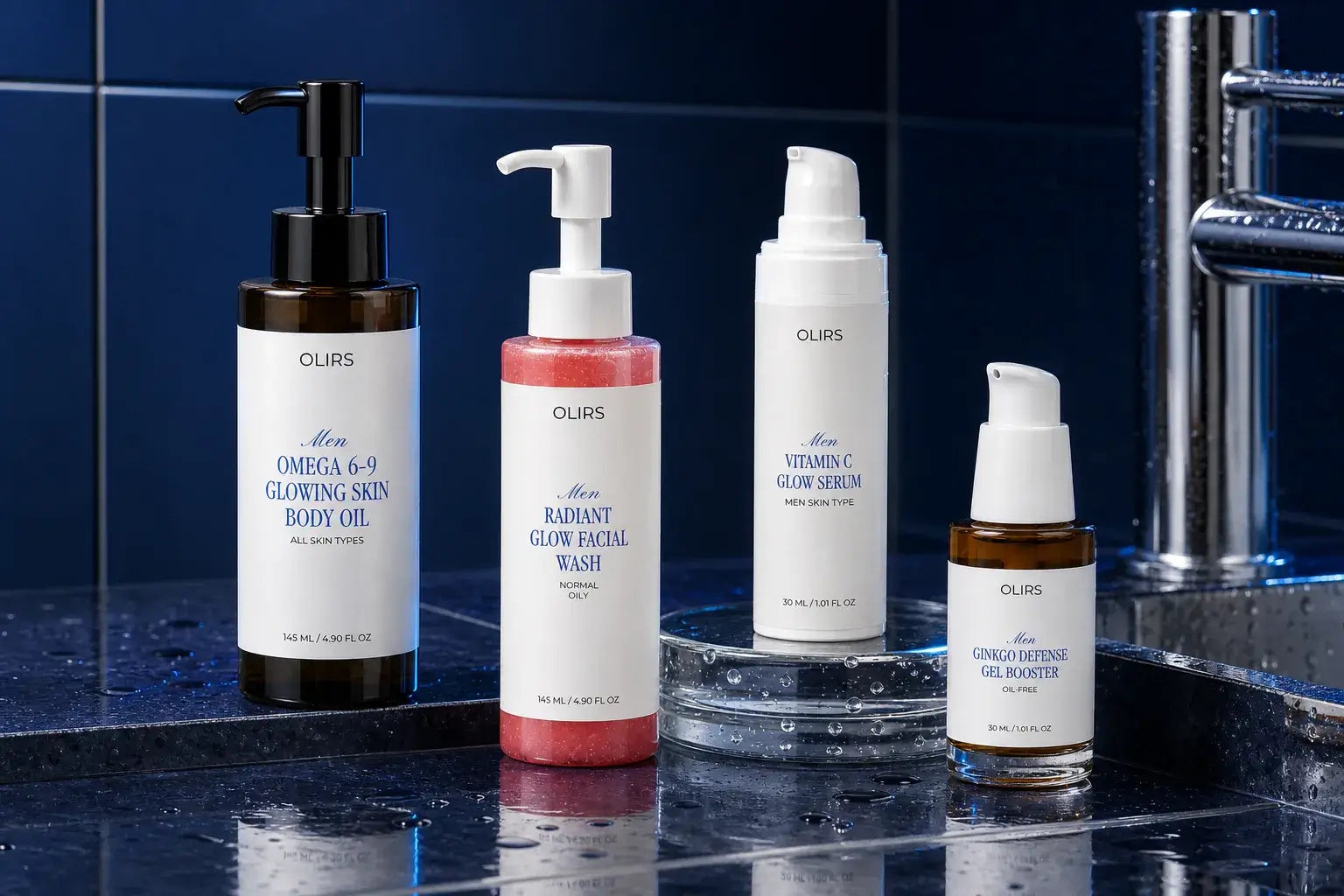
You've got 20 minutes between the alarm and the door, eight hours under fluorescent light and central air, then a commute that undoes half of it. A skincare routine for office job men has to survive that schedule, not fight it. TL;DR A 3-step morning routine before a 9-to-5 beats a 7-step one you'll skip by Wednesday. Office HVAC pulls moisture from skin all day — a lightweight moisturizer at your desk matters more than a fancy serum. Radiant Glow Facial Wash and Oil-Free Zinc Face Gel cover the two failure points of an office day: morning rush and midday shine. Buy both if you sit under AC 8+ hours. Skipping the evening step because you're tired is the single biggest reason routines die inside 30 days. Why this matters Office skin has two enemies most routines never name: recycled HVAC air and screen glare. Central air strips humidity, which is why a lot of guys notice tightness by 3pm even on skin that looks fine at 8am. That's not a product problem. It's an environment problem, and the fix is picking a moisturizer built for barrier support, not fragrance. Most skincare content is written for a bathroom with no clock on it. A simple skincare routine for men that assumes unlimited morning time doesn't survive a real 9-to-5 in 2026, where the average commute eats into the exact window you'd need for a 6-step regimen. The fix isn't fewer ingredients. It's fewer steps, done in the right order, at the right time of day. What you'll need A gentle cleanser that doesn't strip skin before you sit under AC for eight hours — Radiant Glow Facial Wash fits this; check the INCI list before buying anything, not the marketing copy A lightweight daily moisturizer that layers under a collar without feeling greasy A shine-control gel for the 1pm-to-5pm stretch, not just the morning A travel-size version of whatever you use at your desk drawer 90 seconds in the morning, 45 seconds at your desk, 3 minutes at night — that's the entire time budget You don't need ten products. You need three that do specific jobs at specific hours. The steps 1. Cleanse before you're dressed, not after Wash your face before you put on a shirt, not after — sweat and product from the shower can transfer to fabric and irritate skin along the collar line. Use a cleanser for 30 seconds, cool water, pat dry. Cold water doesn't close pores (that's not how skin works), but it does keep morning redness down before you're on camera for a 9am call. Common mistake: using bar soap meant for the body on your face. Body soap runs more alkaline and can leave facial skin tight and flaky by lunch, which reads as dry skin when it's actually a pH mismatch. 2. Moisturize while your commute clock is still running Apply moisturizer within 60 seconds of cleansing, while skin is still slightly damp — this traps more water at the surface than applying to fully dry skin. If you're indoors under HVAC for 8+ hours, a formula built around hyaluronic acid pulls in more moisture than one relying on oil alone. Common mistake: skipping moisturizer because the office feels warm. Warm air can still be dry air. Central heating and air conditioning both lower relative humidity, which is the actual variable that matters to skin, not the temperature on the thermostat. 3. Keep a desk version for the 2pm shine check Midday shine on the nose and forehead is oil production responding to stress hormones and recycled indoor air, not "bad skin." A blotting step or a light gel reapplication at your desk handles it in under a minute. The Oil-Free Zinc Face Gel for Men is built for exactly this window — a formula that controls shine without adding weight under a collared shirt. Common mistake: using facial oil at your desk to "fix" shine. Oil on top of oil compounds the problem by early afternoon. 4. Match your evening step to how the day actually went If you were at a desk all day: a normal cleanse and moisturize is enough. If you hit the gym before or after work: rinse sweat off within 20 minutes to limit clogged pores along the hairline and jaw, a known driver of gym-related breakouts. A hyaluronic acid face cream at night rehydrates skin that spent the day under dry office air, which is when barrier repair actually happens. Common mistake: treating the evening routine as optional because you're tired. This is the step that gets skipped most, and it's the one doing the most repair work. 5. Build a drawer kit so travel doesn't break the routine Keep a small version of your cleanser and moisturizer in your desk or gym bag. A routine that only exists at home dies the first week you have an early flight or a late meeting. Consistency, not intensity, is what shows up in how skin looks after 90 days. Common mistake: buying a second full routine "for travel" instead of just decanting what you already use. Same ingredients, same result, less clutter. 6. Reset on the weekend, don't add more Weekends are for catching up on anything you skipped, not for adding a fifth product. If you missed the evening step twice during the week, that's the one to prioritize Saturday and Sunday. Adding a new active on a day you also have more free time is how irritation gets misdiagnosed as "the product not working." Troubleshooting Skin feels tight by lunch even after moisturizing. The formula is likely too light for how dry your office actually is. Layer a facial oil over your moisturizer twice a week rather than switching products entirely. Breakouts along the jaw and cheeks specifically. Check your phone screen and desk surface — bacteria transfer from touch points is a documented driver of jawline breakouts in people who rest their face on their hand during calls. Redness that shows up on video calls but not in the mirror. Camera lighting and compression exaggerate redness that's barely visible in person. This is a lighting artifact more often than a skin change — don't overhaul your routine based on a Zoom screenshot. Routine keeps falling apart mid-week. You likely built a routine for a version of your week that doesn't exist. Cut a step before adding one. A 2-step routine you actually do beats a 5-step one you do on Mondays only. Product stings slightly when applied. Stop using it for 48 hours. A mild formula shouldn't sting on intact skin — if it does consistently, that's a sign to check the ingredient list for something you're reacting to, not to push through it. Built for the 9-to-5 schedule Oil-Free Zinc Face Gel for Men Lightweight, easy-to-use moisturiser built for a daily men's routine. €26 Hyaluronic Acid Face Cream for Men Simple daily moisturiser for men, works alone or layered into a routine. €18.70 Fresh Skin Routine Set Three-step routine: cleanser, day cream, and support for fresh, hydrated skin. €69.70 Tools and resources A cleanser and moisturizer you can decant into travel sizes without losing efficacy A desk drawer kit: shine-control gel, a small mirror if your monitor's reflection isn't enough Olirs is COSMOS NATURAL certified through Ecocert — that means a third party audited every ingredient and the extraction method behind it, which is worth checking before you commit a whole routine to any brand, this one included A calendar reminder for the first two weeks, until the routine becomes automatic rather than a decision What to do next Once the 3-step version is automatic, the next question is sequencing actives — what goes before what, and which ones shouldn't be layered on the same night. That's a separate problem from timing, and one worth reading a dedicated routine-building guide for before you add anything. FAQ What's the best skincare routine for office job men in 2026? A 3-step routine — cleanser, moisturizer, and a midday shine-control step — is the most realistic option for a full 9-to-5 schedule in 2026. Anything longer tends to get skipped by the second week of a busy quarter. How much time does an office skincare routine actually take? About 90 seconds in the morning, 45 seconds at your desk for shine control, and 3 minutes at night. That's under 5 minutes of total daily time, spread across the day instead of stacked in one block. Does sitting under air conditioning all day actually dry out skin? Yes — HVAC systems lower relative humidity indoors, which pulls moisture from the outer skin layer over an 8-hour day. A lightweight moisturizer with hyaluronic acid addresses this better than skipping hydration because the office feels warm. Is a facial oil or a gel moisturizer better for an office job? A gel or lightweight cream layers better under a collared shirt and dries faster before you leave for work. Facial oil works well at night when you're not rushing out the door, but it can add unwanted shine if applied right before a full workday. How do I stop midday shine without reapplying makeup or oil? A zinc-based, oil-free gel reapplied in under a minute at your desk controls shine without adding weight. Blotting alone removes oil but doesn't address the production, so it comes back within an hour. Can a gym-before-work routine and an office routine coexist? Yes, but sweat needs to be rinsed off within about 20 minutes of a workout to limit clogged pores along the hairline. Keep a travel-size cleanser in your gym bag rather than trying to do a full routine at your desk after training. Why does my skin look fine in the mirror but red on video calls? Camera lighting and video compression tend to exaggerate redness that's barely visible in person. Don't change your routine based on how skin looks on a laptop camera alone — check it in natural daylight first. How long before a new office skincare routine shows a difference? Most men notice skin feeling less tight by the end of week two, with texture changes becoming more visible around 90 days of daily use. Skin cell turnover takes weeks, not days, so a routine needs a real trial period before you judge it. One last thing The step men skip most in a 9-to-5 routine isn't the moisturizer — it's the midday check. A morning and night routine covers 16 of your waking hours; the other 8 sit under office lighting and recycled air with zero attention, which is exactly the window where shine and tightness build up unnoticed until a video call points it out. Related guides Skincare routine set for gym mornings A simple skincare routine for men who hate fuss
Learn more
Best Natural Cleanser for Combination Skin, Ranked 2026
Combination skin means an oily T-zone and drier or normal cheeks fighting for the same bottle of cleanser, and most "natural" formulas pick a side. This guide ranks the cleanser formats and specific OLIRS products that actually work across both zones in 2026, with plain verdicts on what to buy and what to skip. TL;DR Gentle Cleansing Milk is the safest pick for combination skin thanks to traceable shea, argan and jojoba oils. Buy. Daily Clarifying Gel Cleanser handles the oily T-zone without over-drying cheeks at $28.40. Buy for AM use. Foam and mousse formats vary widely on surfactant load, so check the INCI before buying either one. The best natural cleanser for combination skin in 2026 is usually two products, not one: a gel for morning, a milk for night. COSMOS Natural certification means an outside auditor checked the ingredients, not that the product is organic. What the catalog actually shows 6 Cleanser formats currently sold gel, milk, foam, mousse, wash, zinc gel 2 products With full origin tracing to region 30 days Return window if a formula doesn't suit you Why this matters Combination skin isn't a diagnosis, it's a math problem: sebum production runs high on the forehead, nose and chin, and low to normal everywhere else. A cleanser strong enough to cut oil in the T-zone will usually leave the cheeks feeling tight by midday. A cleanser gentle enough for the cheeks often leaves the T-zone shiny by noon. That's why a single "best natural cleanser for combination skin" answer rarely works for every guy. What matters more is matching the surfactant system and texture to where you're actually oily, and reading the certification and INCI list instead of trusting the front-of-bottle copy. If you want the deeper breakdown on which OLIRS formula pairs with combination skin specifically, the face oil guide for men with combination skin covers the moisturizing side of the same problem. COSMOS Natural, the certification OLIRS holds, isn't a marketing badge — it means Ecocert audited every ingredient and how it was extracted. That's different from COSMOS Organic, which OLIRS does not carry. Worth knowing before you assume "natural" means "organic," because they're two separate standards with two separate audits. How this list was ranked Every cleanser here got evaluated on four things: whether the surfactant base is mild enough for daily use, whether the format (gel, milk, foam, mousse) actually matches an oily T-zone or drier cheeks, whether the ingredient sourcing is documented enough to verify, and whether the certification claims (Vegan, Cruelty-Free, COSMOS Natural) hold up against the product page's own listed standards. Nothing here is ranked on price alone or on a founder's opinion. If a product's origin fields are blank in 2026, it gets flagged as blank — not filled in with a guess. That's the same standard the brand applies to its own "From Farm To Face" slogan, which only two OLIRS products can currently back with real sourcing data. The ranked list 1. Gentle Cleansing Milk — the traceable pick Shea (West Africa/Sahel), argan (Morocco's UNESCO argan biosphere reserve) and jojoba (Mediterranean basin), all cold-pressed. This is one of only two OLIRS products that can back the "From Farm To Face" slogan with actual sourcing data as of 2026. The milk texture doesn't foam, which means it doesn't strip the drier cheek zones that combination skin sufferers usually complain about. Use it at night, when you're not fighting midday oil. Verdict: Buy, especially for PM use. See the Gentle Cleansing Milk product page. 2. Daily Clarifying Gel Cleanser — the T-zone fix An aloe-based gel formulated for oily and normal skin, priced at $28.40. The lather is soft, not stripping, and it rinses clean without leaving a tight feel behind — which is the exact complaint combination-skin guys have about most gel cleansers. This is the AM half of the routine: use it where oil actually builds up, not across the whole face if your cheeks run drier. Verdict: Buy for morning use. Check the Clarifying Gel listing. 3. Cleansing Foam — the one to vet yourself The format name tells you the texture, not the formula. Foaming cleansers run a wide range on surfactant strength — some are mild, some strip the skin barrier in under two weeks of daily use. There's no published INCI breakdown here beyond the format name. Before buying, read the ingredient list on the product page and compare it against the certification claims. That's not a dodge — it's the actual advice for a foam cleanser you haven't used before. Verdict: Hold until you've checked the INCI. 4. Purifying Mousse — the airy oil-control option Mousse formats are aerated, which usually means a lighter feel on application than a straight gel. For an oily T-zone that still needs to breathe by afternoon, that lightness can be an advantage. Same caveat as the foam above: verify the surfactant list and certification badges before committing, since "mousse" describes a texture, not a formula strength. Verdict: Consider, after reading the label. 5. Radiant Glow Facial Wash — skip for pure oil control The name signals a brightening focus rather than a combination-skin, oil-balancing one. If your main complaint is shine by midday and tightness on the cheeks, this isn't built to solve that specific problem — it's built for dullness. Verdict: Skip if combination-skin balance is your only goal. 6. Oil-Free Zinc Face Gel for Men — the shine-control specialist Zinc is named directly in the product, and it's a standard cosmetic ingredient used for oil absorption and a mattified look. An oil-free gel base fits an oily T-zone well, though it's a narrower fix than a full-face cleanser system. Verdict: Consider if shine control, not dryness, is the bigger problem. 7. Fresh Skin Routine Set — the ready-made system A three-step bundle at $69.70 built around the Clarifying Gel, so the T-zone-focused cleanser above comes with a matching moisturizer already picked out. Skips the guesswork of building a routine product by product. Verdict: Buy if you want the whole AM/PM system without shopping each step separately. See the Fresh Skin Routine Set. 8. Glowy Skin Trio Collection Box — the milk-cleanser bundle At $86.70, this bundle pairs the Gentle Cleansing Milk from pick #1 with a day cream, which makes sense if the traceable-origin cleanser is the one you want but you'd rather not buy the moisturizer separately. Verdict: Buy for guys prioritizing the drier-skin side of combination. A cleanser that leaves your T-zone shining by 10am and your cheeks tight by noon isn't a combination skin cleanser — it's two problems wearing one label. What to avoid A single cleanser marketed as "for all skin types" with no format detail. Combination skin needs a format decision (gel vs. milk), not a vague catch-all. Anything claiming to "treat" or "fix" oily skin permanently. No cleanser changes sebum production long-term — it manages how skin looks and feels day to day, nothing more. Skipping the certification check. "Natural" on a label means nothing without a third-party audit behind it. COSMOS Natural is one standard; look for it, or its equivalent, before trusting the word. Comparison table Product Format Best for Verdict Gentle Cleansing Milk Cream/milk, non-foaming Drier cheeks, PM use Buy Daily Clarifying Gel Cleanser Gel, aloe-based Oily T-zone, AM use Buy Cleansing Foam Foam Unknown surfactant strength Hold, check INCI Purifying Mousse Aerated mousse Light daytime cleanse Consider Radiant Glow Facial Wash Wash Dullness, not oil control Skip for this use case Oil-Free Zinc Face Gel for Men Oil-free gel Shine control only Consider Cleansers worth checking Daily Clarifying Gel Cleanser Aloe-based gel cleanser for oily and normal skin, rinses clean without a tight feel. €28.40 Fresh Skin Routine Set Three-step routine built around the Clarifying Gel for oily and normal skin. €69.70 Glowy Skin Trio Collection Box Gentle Cleansing Milk paired with a Firm-Look Day Cream for a soft, comfortable cleanse. €86.70 Where to buy Buy from the product page directly on olirs.com and check the listed INCI before adding to cart — don't rely on the category name alone. Confirm the certification badges shown match what's claimed in the description: Vegan, Cruelty-Free, COSMOS Natural where applicable. If a formula doesn't suit your skin after a trial period, the 30-day return window on unused, unopened bottles is the fallback — check the current policy text on the site before buying. FAQ What's the best natural cleanser for combination skin in 2026? Gentle Cleansing Milk and Daily Clarifying Gel Cleanser cover both ends of combination skin: the milk for drier cheeks at night, the gel for the oily T-zone in the morning. Using one product for both zones usually means compromising on one of them. Is a gel or cream cleanser better for combination skin? Gel cleansers work better on the oily T-zone because they cut through sebum without heavy emollients. Cream or milk cleansers suit drier cheeks better since they don't foam or strip. Many men with combination skin use both, split by time of day. How often should I use a clarifying gel cleanser on combination skin? Once or twice daily depending on how oily the T-zone runs. Over-cleansing strips the skin barrier and can trigger more oil production as a rebound effect, so twice a day is the usual ceiling. Does COSMOS Natural certification mean a cleanser is organic? No. COSMOS Natural and COSMOS Organic are two separate Ecocert standards with two separate audits. A COSMOS Natural cleanser has been checked for natural-origin ingredients and extraction methods, not certified organic. Can I use the same cleanser morning and night on combination skin? You can, but it usually means picking a compromise formula rather than the best fit for either zone. A gel in the morning and a milk at night addresses the T-zone and cheeks separately instead of splitting the difference. What ingredients should I avoid in a cleanser for combination skin? Watch for high concentrations of sulfates and drying alcohols, which strip the drier cheek areas even while barely touching T-zone oil. Reading the INCI list in order of concentration tells you more than the front-of-bottle claims. How much does a natural face cleanser cost in 2026? Single cleansers in the OLIRS catalog run around $28 to $28.50, while three-step bundles that include a cleanser range from roughly $69.70 to $86.70 depending on the set. One last thing Only two products in the entire OLIRS catalog can currently trace their oils to a specific region and pressing method — Gentle Cleansing Milk is one of them. That's not a marketing gap to smooth over; it's a reason to start with the products that can actually back their claims and wait on the rest until the sourcing data catches up. Related guides Face oil for men with combination skin Natural face wash for oily skin Gentle facial cleanser for sensitive skin
Learn more
How to Fix Dandruff on Shoulders (2026 Routine)
Dandruff on your shoulders is a laundry problem before it's a scalp problem — the flakes you see on a dark shirt collar are days of buildup finally shaking loose. Fix the routine that sheds it in the shower, not the shirt you're wearing. TL;DR How to fix dandruff on shoulders starts at the scalp: buildup sheds as flakes, not more product on top. Wet hair against fabric spreads flakes further — dry fully before you dress, every single day. A twice-weekly scalp routine with a proper shampoo clears visible buildup within about two weeks. Persistent redness or itching past flaking is a dermatologist question, not a stronger-shampoo question. Why This Matters Scalp skin turns over constantly, and the top layer sheds in small clumps that are supposed to be invisible. When oil, product residue, or a dry scalp speed that shedding up, the clumps get bigger and lighter-colored — and they land on your shoulders the second you move your head. That's the whole mechanism. It's not dirt, and it's not about how often you shower your body. It's what's happening one layer up, on your scalp, that you can't see in a mirror. The fix isn't a miracle formula. It's sequencing: what you wash with, how often, and how dry your hair is before it touches fabric. Get that sequence right and the flakes stop showing up on collars before you even notice them building. What You'll Need A shampoo built for scalp buildup, not just hair texture — the Keratin Volume Boost Shampoo works as a daily option if your current one is leaving residue A body-and-scalp wash for gym days when a full hair wash isn't practical — the 2-in-1 Hair & Body Wash for Men covers both in one step A soft-bristle scalp brush or your fingertips — no metal combs against the scalp A microfiber towel or low-heat dryer setting 10 minutes, twice a week, minimum None of this requires a diagnosis. Most shoulder flaking in 2026 is buildup and drying habits, not a chronic scalp condition — treat it that way first and see what changes in a week. The Steps 1. Rule out buildup before you blame your scalp Run a finger along your scalp the morning after a wash. If it feels waxy or you see white flakes clump rather than sit loose and dry, that's product or oil buildup, not dry skin. Buildup responds to washing frequency. Dry-skin flaking responds to less washing and more moisture. Confusing the two is why most men's routines backfire — they add product to a scalp that already has too much on it. 2. Wash on a schedule, not by feel Washing every day strips natural oil and can trigger more flaking as the scalp overcorrects. Skipping washes for a week lets buildup accumulate and shows up on shoulders by day four or five. The middle ground that works for most routines: every 48 hours. Consistency matters more than the exact product — pick a cadence and hold it for three weeks before judging results. 3. Massage the scalp for a full 60 seconds Shampoo sitting on top of hair does almost nothing for the scalp underneath it. Work the lather into the scalp itself with fingertips — not nails — for a full 60 seconds before rinsing. This is where buildup actually lifts. Most men rinse at 15 seconds because that's how long it takes to feel clean, not how long it takes to work. 4. Rinse until the water runs completely clear Residual shampoo or conditioner left on the scalp is one of the most common causes of shoulder flaking that nobody suspects — it dries, flakes, and looks identical to dandruff. Rinse for a full extra 30 seconds past the point where it feels done. If your water runs even slightly cloudy when you tip your head back, keep going. 5. Dry hair fully before you get dressed Damp scalp skin sheds more easily against fabric friction than dry skin does — wet flakes stick to collars and stay stuck through a whole shift. Towel-dry to the point of no dripping, then either air-dry for 15 minutes before dressing or use a dryer on low heat. Skipping this step undoes steps 1 through 4 entirely. 6. Separate your hair routine from your beard and body routine Using the same bar of soap on scalp, face, and body concentrates oil and residue in one place instead of clearing it. If you're already using a facial cleanser like the Radiant Glow Face Wash — wait, keep that one for your face only. Scalp gets its own product. This is a common shortcut that looks efficient and quietly makes shoulder flaking worse. 7. Brush out loose flakes before they migrate A soft scalp brush used dry, once daily for 20 seconds, physically removes the flakes that are already loose before they fall on their own schedule — usually onto a shirt at your desk. This isn't a cure step. It's a control step, and it's the one most routines skip entirely. 8. Know when it's past a routine fix If flaking comes with visible redness, persistent itching, or patches that look inflamed rather than just dry, that's outside what a shampoo swap resolves. A dermatologist can identify what's actually happening on the scalp in a way no product claim should try to. This routine helps with buildup-driven flaking. It won't resolve an underlying scalp condition, and no shampoo honestly will. Scalp routine essentials Max Volume Boost Shampoo Daily shampoo with hydrolyzed keratin, rosemary leaf oil, and peppermint for a refreshed scalp feel. €29.40 Keratin Rescue Hair Mask Rich hair mask with hydrolyzed keratin and chanterelle extract for soft-feeling hair. €36.40 Troubleshooting Flakes are back within a day of washing. You're likely rinsing too fast (step 4) or the scalp is overcorrecting from washing too often. Stretch the interval to a full 48 hours and rinse an extra 30 seconds. White residue on the shirt collar even right after a shower. Check hair dryness before dressing — this is almost always step 5, not the shampoo itself. Scalp feels oily by midday and flaking gets worse. An oily scalp sheds more visibly because loose skin cells stick to excess sebum instead of falling away clean; pairing the right wash cadence with something built for oil control matters as much as the product itself, which is the same logic behind most shampoos for oily scalp recommendations. Flaking is worse on your beard line, not just your scalp. That's a separate routine — a facial cleanser matched to beard skin, not your scalp shampoo, handles that area. It's worse in winter. Indoor heating dries scalp skin further. Cut wash frequency slightly and make sure the scalp isn't sitting damp under a hat for hours. You've done all six weeks and nothing's changed. That's your signal to see a dermatologist rather than rotate through more shampoos. Routine fixes buildup-driven flaking. It doesn't fix everything that looks like it. Tools And Resources A gym-morning routine built around this exact sequencing if you're washing scalp and body back to back before work The 2-in-1 Hair & Body Wash for a single-step gym-day option A soft scalp brush, kept separate from any brush used on the face A low-heat dryer setting or 15 minutes of patience before you get dressed “Flakes on a dark shirt aren't a hygiene failure. They're skin cells shedding faster than you're clearing them, and clearing them is a schedule, not a scrub.”What To Do Next Once shoulder flaking is under control, the next thing worth checking is whether your face routine is doing the same job it should — a simple skincare routine built for men who hate fuss covers the same buildup-and-consistency logic applied to skin instead of scalp. Read the ingredient list on whatever you switch to next. That's the whole OLIRS position: check the label, don't take a claim on faith. FAQ How do I fix dandruff on my shoulders fast? Wash on a 48-hour cycle, massage the scalp for a full 60 seconds, rinse an extra 30 seconds, and dry hair completely before dressing. Most buildup-driven flaking visibly improves within two to three weeks of consistent washing. Is dandruff on shoulders the same as dandruff on the scalp? It's the same flaking, just visible somewhere else. Shoulder flakes are scalp flakes that have already fallen and stuck to fabric, usually because hair was damp when you got dressed. Should I wash my hair every day if I have dandruff? No. Daily washing can strip oil and trigger the scalp to overcorrect with more oil and more visible flaking. Every 48 hours is a more reliable starting cadence for most routines. Does a dandruff shampoo work better than a regular one? A shampoo built to clear buildup, used with proper scalp massage time and full rinsing, matters more than any single label claim. Technique fixes more shoulder flaking than product swaps alone. Why does dandruff get worse in winter? Indoor heating and hats trap dry, damp air against the scalp, which speeds up flaking. Cutting wash frequency slightly and letting hair air out under a hat helps. When should I see a dermatologist about dandruff? If flaking comes with redness, persistent itching, or inflamed patches after several weeks of a consistent routine, a dermatologist can identify what a shampoo swap can't fix on its own. Can body wash double as a scalp wash? A 2-in-1 hair and body wash works fine for gym days when a full routine isn't practical, but it shouldn't replace a dedicated scalp shampoo on your main wash days. Does brushing help with dandruff? A soft scalp brush used dry for 20 seconds removes flakes that are already loose before they fall on their own, which reduces what ends up on a collar during the day. One Last Thing The detail almost nobody checks: the rinse. Most shoulder flaking that survives a shampoo swap in 2026 is leftover product drying on the scalp, not new buildup — rinse for a full 30 seconds past the point where it feels done, every time, and watch how much less ends up on your collar by week two. Related Guides Keratin Intensive Rescue Hair Mask for scalp and hair recovery A simple skincare routine for men who hate fuss
Learn more
Best Face Serum for Dark Circles Men 2026: Ranked
Dark circles on a man's face come from one of three mechanisms — thin skin showing blood vessels, pigment buildup, or fluid pooling — and picking the wrong serum for the wrong cause is why most men give up on eye care after two weeks. This guide ranks the OLIRS options built for the under-eye area by what's actually in them, not by reviews, because there aren't any yet worth citing. TL;DR OLIRS 3-in-1 Eye Cream for Men is the best face serum for dark circles men who want puffiness, tone, and fine lines covered in one step. Buy. Peptide Age-Defying Eye Cream targets thinning under-eye skin with peptides — the mechanism behind visible blood vessels. Consider. Vitamin C Glow Serum (26.40 euro) uses stabilised vitamin C and ferulic acid for discoloration, not puffiness. Buy for tone, not swelling. Peptide Firm-Look Serum (42.40 euro) layers two molecular weights of hyaluronic acid for hydration-related shadowing. Consider. COSMOS Natural certification means an outside auditor checked every ingredient in these formulas — verify it yourself on the product page. What the label actually says 6 Third-party certifications on OLIRS formulas 26.40-42.40 euro Price range across serum picks 2026 pricing 30 days Return window, unused product Why this matters Dark circles aren't one problem. Puffiness is fluid retention. Discoloration is pigment or visible vasculature through thin skin. Hollowing is volume loss, and no topical serum fixes that — that's a filler conversation, not a skincare one. A serum built for pigment won't touch puffiness, and a peptide cream won't lighten a genuinely dark tone. That's the whole reason to check the 3-in-1 Eye Cream for Men ingredient list before buying anything labeled "for dark circles" in 2026 — the phrase on the box tells you the marketing angle, not the mechanism. Read what's actually in the tube. How this list was built Every pick here is ranked by ingredient function against the three causes above, cross-checked against what OLIRS' COSMOS Natural certification actually covers — a third-party audit of every ingredient and how it was extracted, not a self-declared "clean" label. No customer reviews were used because none exist yet on this catalog worth quoting. No before/after photos are cited either, since none of that exists for these specific SKUs. What counted: the named active ingredient, its documented function (brightening, firming, hydrating), and whether the format (cream vs. oil-serum) makes sense for the eye area specifically. Products with blank ingredient data on their pages got skipped, not guessed at. The ranked list 1. OLIRS 3-in-1 Eye Cream for Men — the one-step pick One product, three jobs claimed on the label: tone, puffiness, and fine lines. That's the appeal for a man who wants a single step in a 2026 morning routine instead of stacking three separate tubes. Before you commit, read the full INCI on the product page — a multi-benefit claim only holds up if the actives back each benefit individually, and that's worth checking rather than assuming. If the label backs all three claims with named actives, this is the simplest entry point into an eye routine. Buy if you want one product and are willing to verify the ingredient list yourself first. 2. Peptide Age-Defying Eye Cream — the thinning-skin pick Peptides work on the skin's own structural proteins, which matters specifically for under-eye skin — it's thinner than the rest of the face, which is exactly why blood vessels show through it as a dark or bluish tint as men move through their 30s and 40s. This isn't a fix for pigment. If your circles look more brown than blue-purple, peptides are the wrong mechanism and you're better off with a brightening active instead. Check the product page for the exact peptide named before buying — "peptide complex" without a specific name on the label is a red flag in any category, not just this one. Consider it if your circles read as shadowy rather than discolored. 3. Vitamin C Glow Serum — the discoloration pick Stabilised vitamin C paired with ferulic acid is the combination dermatology literature keeps coming back to for brightening and antioxidant support, and OLIRS' version pairs it with hyaluronic acid so it isn't drying skin out while it works. At 26.40 euro this is the cheaper serum on this list, and it's built for tone correction, not fluid retention — don't expect it to touch morning puffiness. Use it under the eyes at night or in the morning under sunscreen; vitamin C can make skin more photosensitive-adjacent in practice, so daytime SPF still matters regardless of what's in the bottle. Buy if pigment, not puffiness, is the complaint. 4. Peptide Firm-Look Serum — the hydration-layering pick Two molecular weights of hyaluronic acid means one sits on the surface and one sits deeper, which is the standard way to layer hydration without it evaporating off in an hour. Peptides here are positioned for firmness and fine lines across the whole face, not eye-specific, so this reads as a face serum that happens to work fine near the eye area rather than a dedicated eye product. At 42.40 euro it's the priciest pick here, and that's the trade for a full-face formula instead of a small-format eye tube. Consider it if you want one serum doing double duty across cheeks and under-eyes, not a dedicated eye step. Comparison table Product Best for Mechanism Price Verdict 3-in-1 Eye Cream for Men Puffiness + tone + lines in one step Multi-benefit, verify actives on page See product page Buy Peptide Age-Defying Eye Cream Thinning skin, visible vessels Named peptide, verify on page See product page Consider Vitamin C Glow Serum Discoloration, uneven tone Stabilised vitamin C + ferulic acid 26.40 euro Buy for tone Peptide Firm-Look Serum Hydration + firmness, full face Dual-weight hyaluronic acid + peptides 42.40 euro Consider “Puffiness responds to cold and caffeine. Discoloration responds to brightening actives. Hollowing responds to nothing you apply on top.” Serums worth checking against your cause Vitamin C Glow Serum Stabilised vitamin C, ferulic acid and hyaluronic acid for a brighter, more even-looking complexion. €26.40 Peptide Firm-Look Serum Daily peptide serum with two molecular weights of hyaluronic acid for firmer-looking, hydrated skin. €42.40 Where to buy Buy direct from the OLIRS product page so you're reading the current, live ingredient list — INCI lists change between batches more often than people assume. Don't buy a dark-circle serum from a third-party marketplace listing with no visible full ingredient panel. If you can't read the INCI before purchase, skip it. Check the certification claims (Vegan, Cruelty-Free, Gluten-Free, Nut-Free, Paraben-Free, COSMOS Natural) against the product page directly rather than taking a screenshot's word for it — certifications are auditable, so use that. FAQ What actually causes dark circles in men? Dark circles come from thin under-eye skin showing blood vessels, pigment buildup, or fluid retention causing puffiness. Each cause needs a different ingredient, which is why one generic eye cream doesn't fix every case. Is a face serum different from an eye cream for dark circles? Yes. An eye cream is formulated for the thinner, more sensitive skin around the eye, while a face serum like Vitamin C Glow Serum is built for the whole face and can be used near the eye area if the formula is gentle enough. How long before you see a difference using a serum on dark circles? Most active ingredients like vitamin C or peptides need consistent daily use for several weeks before visible change shows, since skin cell turnover isn't instant. Puffiness from cold or caffeine-based products responds faster, often within minutes. Can vitamin C help with dark circles in 2026? Vitamin C paired with ferulic acid supports a brighter, more even-looking tone, which helps with pigment-based discoloration specifically. It does not reduce puffiness or fluid retention under the eyes. Do peptides actually work on under-eye skin? Peptides support the skin's own structural proteins, which can help with the appearance of thinning skin and fine lines. They work slower than exfoliating actives and won't correct pigment-based discoloration. Is COSMOS Natural the same as organic? No. COSMOS Natural and COSMOS Organic are separate Ecocert certifications with different ingredient sourcing thresholds. OLIRS holds COSMOS Natural, which means an outside auditor checked every ingredient and its extraction method. How much does a men's dark-circle serum cost in 2026? OLIRS eye and brightening serums range from roughly 26.40 to 42.40 euro depending on the formula, with eye-specific creams priced separately on their own product pages. Price generally tracks with ingredient complexity, not marketing claims. Should you use a serum, an eye cream, or both? If your cause is discoloration, a brightening serum like Vitamin C Glow Serum addresses tone directly. If your cause is thinning skin or puffiness specifically at the eye, a dedicated eye cream like the 3-in-1 Eye Cream for Men is built for that thinner skin zone. One last thing OLIRS' full catalog carries six third-party certifications — Vegan, Cruelty-Free, Gluten-Free, Nut-Free, Paraben-Free, and COSMOS Natural — checkable on any product page, no exceptions and no asterisk. That's a higher verification bar than most brands in this category bother clearing, and it's worth confirming yourself before you buy anything for the eye area in 2026, since that's skin you can't afford to guess on. Related guides Eye patches for tired-looking eyes
Learn more
How to Tell If Natural Skincare Is Real (2026 Guide)
Most "100% natural" claims on a skincare label are unverifiable in about ten seconds — you just need to know where to look. TL;DR Read the INCI list before the marketing copy — ingredient order shows what's actually in the bottle. A real natural skincare claim names a certifier and license number, like COSMOS Natural from Ecocert. OLIRS discloses COSMOS Natural, Vegan, and Cruelty-Free status openly: verdict is read the label yourself, don't take the claim on faith. 'From Farm To Face' sourcing only means something when a brand names the region and extraction method. Skip any 'all-natural' claim with no certifier attached — that's the fastest tell it's unverifiable. What to actually check 6 Certifications OLIRS holds Vegan, Cruelty-Free, Gluten-Free, Nut-Free, Paraben-Free, COSMOS Natural 2 Products with full origin traceability as of 2026 Why this matters "Natural" has no legal definition on a skincare label in the US or the EU. Any brand can print it. That's exactly why the men's skincare category is flooded with the word and almost never backs it up with anything a stranger could check. OLIRS built its whole approach around the opposite bet: name the certifier, publish the ingredient list, and let the reader verify it instead of asking him to trust a bottle. That habit — reading the label before you buy — is the entire skill this guide teaches. It takes five minutes once you know the steps. What you'll need The product's ingredient list (INCI), either printed on the packaging or listed on the product page A phone or laptop and about five minutes Access to a public ingredient database (INCIDecoder, EWG Skin Deep, or the certifier's own registry) The name of any certification claimed on the label (COSMOS Natural, Leaping Bunny, USDA Organic, etc.) The steps 1. Read the ingredient list top to bottom, not the front of the label INCI (International Nomenclature of Cosmetic Ingredients) lists ingredients in descending order by concentration, down to 1%. Below 1%, brands can list ingredients in any order. This means the first five names on the list tell you more about the formula than any word on the front of the bottle. If a serum's front label screams "natural" but the first ingredient after water is a synthetic silicone, the claim is describing a minority of the formula. Common mistake: stopping at the first three ingredients and assuming the rest doesn't matter — actives at 1-2% concentration still show up further down and are often the whole point of the product. 2. Confirm the certification is real, not a printed word "Natural" without a logo is a marketing adjective. "Natural" with a certification mark — COSMOS Natural from Ecocert, for example — is a claim a third party audited. COSMOS Natural means an outside body reviewed every ingredient and how it was extracted, not just the final blend. That distinction matters because COSMOS Natural and COSMOS Organic are two separate certifications with different thresholds. A brand holding one is not automatically entitled to claim the other. If a label says "organic" but the only mark you can find is COSMOS Natural, that's a mismatch worth asking about directly. 3. Look up the license number in the certifier's public registry Every legitimate COSMOS certification has a license number tied to the certifying body, usually Ecocert or Cosmebio. If a brand claims the certification but can't produce a number, or the number doesn't resolve in the registry, treat the claim as unverified. This step alone eliminates most fake natural claims — it costs nothing and takes under two minutes. 4. Separate sourcing claims from formulation claims "From Farm To Face" type language is a sourcing claim: it says something about where raw ingredients came from and how they were processed, not what percentage of the formula is plant-derived. A brand can have a legitimate natural certification and still not be able to name the exact farm region for every ingredient in every product — sourcing data gets built product by product, not catalog-wide. On All-In-One Facial Oil, the jojoba, rosehip, and sea-buckthorn are each tied to a named region and a cold-pressed extraction method. That's a sourcing claim you can actually check against the ingredient origin data. A slogan with no region and no extraction method attached is decoration, not proof. 5. Check any percentage or study citation against the primary source "95% naturally derived" or "clinically proven" needs a source with a year and a publication attached. If the brand can't point to the study, the number is unverifiable and should be treated as marketing, no matter how specific it sounds. A real citation reads like "Flament 2013" or "Ghadially 1992," not "studies show." Common mistake: accepting a percentage claim because it sounds precise. Precision is not the same as sourcing. 6. Flag treat/cure/heal language as a red flag, not a selling point Regulated cosmetics in the US and EU are legally barred from claiming to treat, cure, or heal a skin condition — that language belongs to drugs, not cosmetics. A brand using it is either misclassifying its own product or ignoring the rule. Appearance language — "looks smoother," "appears more even" — is the honest, compliant version of the same idea. 7. Check what's absent, not just what's present Paraben-free, gluten-free, nut-free — these are formulation exclusions, and a brand serious about them lists them explicitly rather than burying them in fine print. What's missing from a formula is often more checkable than what's claimed to be inside it, because an exclusion is binary: either the ingredient is there or it isn't. Troubleshooting The ingredient list is a photo, not text. Type the first ten ingredient names manually into a search engine or ingredient database — don't rely on OCR from a screenshot, it misreads INCI names constantly. The certification logo looks unfamiliar. Search the certifying body's name plus "registry" or "verify license." Real certifiers publish public lookup tools; ones that don't are usually self-issued seals with no auditing behind them. The brand cites a study with no year. Treat it as unverifiable until a year and journal are attached. A real citation is checkable in under a minute; a vague one is designed not to be checked. Two nearly identical products, different claims. If a catalog has two similar formulas at different price points making different natural claims, ask which one actually holds the certification — don't assume the pricier one does. The word "organic" appears without a COSMOS Organic mark. COSMOS Natural and COSMOS Organic are not interchangeable. A brand certified Natural cannot claim Organic status without a separate audit. No certifier is named at all. "Naturally sourced" and "nature-inspired" carry zero certification weight — they're phrasing, not audits. Tools and resources A public INCI database (INCIDecoder, EWG Skin Deep) to look up unfamiliar ingredient names in under a minute each The certifying body's own registry — Ecocert publishes license lookups for COSMOS Natural and COSMOS Organic The product's own ingredient page, read before the marketing copy on the same page A comparison read like natural face wash for oily skin if you're applying this check while shopping cleansers specifically What to do next Once you can read an ingredient list and spot a real certification in under five minutes, apply the same scrutiny to routine order — actives that are genuinely useful can still be applied in the wrong sequence and cancel each other out. A simple skincare routine without the guesswork walks through cleanser, serum, and moisturiser order so the ingredients you just verified actually get to do their job. FAQ How to tell if natural skincare is real? Check for a named third-party certifier with a public license number, like COSMOS Natural from Ecocert, and read the ingredient list in order rather than trusting the front-of-bottle claim. If neither exists, the natural claim is unverifiable. Is 'natural' a regulated term on skincare labels? No. In the US and EU, 'natural' has no legal definition on a cosmetics label as of 2026, so any brand can print it without proof. A named certification, not the word itself, is what's checkable. What's the difference between COSMOS Natural and COSMOS Organic? COSMOS Natural certifies the formulation and extraction methods used; COSMOS Organic requires a higher threshold of certified organic raw material. A brand holding one cannot claim the other without a separate audit. Does 'clinically proven' mean anything without a source? Not on its own. A real clinical claim comes with a study name, year, and journal you can look up. A claim with no citation is a marketing phrase, not evidence. How much of a formula does the ingredient order actually reveal? Ingredients above 1% concentration are listed in descending order, so the first five to seven names tell you the bulk of the formula. Below 1%, order can be arbitrary, which is where many actives sit. Can a certified natural product still contain synthetic ingredients? Yes, within the certifier's allowed limits — COSMOS Natural permits a small percentage of synthetic preservatives and stabilizers under defined thresholds. Certification means audited limits, not zero synthetics. What does 'From Farm To Face' actually require to be true? It requires a named region of origin and a stated extraction method for the specific ingredients in that specific product, not a catalog-wide slogan. Only formulas with that origin data attached can honestly carry the phrase. Should I trust a percentage like '95% natural origin'? Only if the brand names the calculation standard behind it, usually ISO 16128. Without that reference, the percentage is a marketing number with no audit trail. One last thing The most overlooked check isn't the ingredient list — it's the extraction method. COSMOS Natural audits don't just confirm what's in a bottle, they confirm how it was pulled out of the plant, because cold-pressing and solvent extraction leave different residues behind. Two products can list the identical top-line ingredient and still earn different certification outcomes because of that one variable. Ask about it, and watch which brands actually have an answer. Related guides Natural face wash for oily skin A simple skincare routine for men who hate fuss Vitamin C serum for dark spots on men's skin
Learn more